Batch Payments Cross Border: The Missing Link in Scalable Global Customer-to-Cash
How cross-border batch payments shift international finance from ad hoc execution to system-level orchestration
Cross-border payments were never designed for scale.
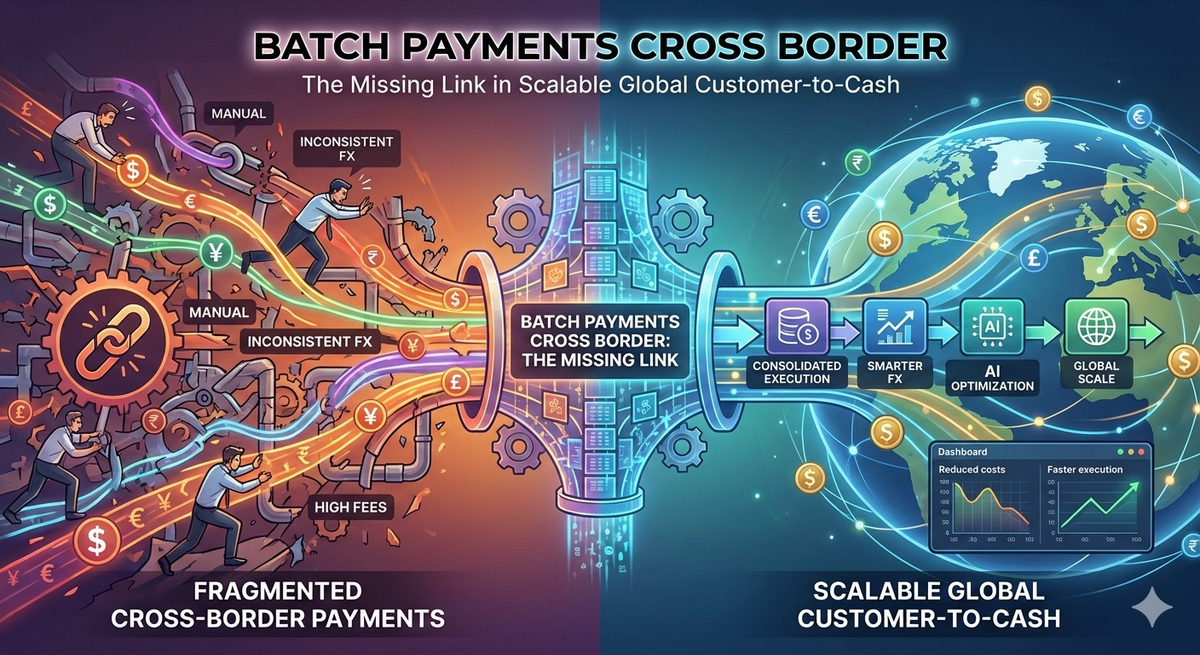
They were built one transaction at a time - a wire here, a local transfer there, each with its own routing, fees, FX exposure, compliance checks, and reconciliation headaches. That approach might work when volumes are low. It breaks down quickly as businesses expand internationally.
As global companies grow, the question is no longer how to send a payment, but how to move money across borders efficiently, repeatedly, and with control.
This is where batch payments cross border become a critical but often overlooked capability in modern customer-to-cash operations.
What Are Batch Payments in Cross-Border Transactions?
Batch payments cross border refer to the ability to group multiple international payments into a single, coordinated execution flow, while still routing each payment optimally based on currency, destination, cost, and risk.
Instead of processing payments one by one, finance teams can:
• Consolidate multiple supplier or partner payments
• Execute them across different countries and currencies
• Maintain visibility, control, and reconciliation at scale
In domestic payments, batching is standard. In cross-border environments, it has historically been difficult due to fragmented banking rails, compliance requirements, and FX complexity.
That is now changing.
Why Cross-Border Batch Payments Matter More Than Ever
Global finance teams face a perfect storm:
• Higher transaction volumes
• More currencies and corridors
• Increased FX volatility
• Stricter compliance requirements
• Pressure to reduce operational costs
Processing international payments individually creates hidden friction:
• Manual review and approvals slow execution
• Inconsistent FX rates inflate costs
• Reconciliation becomes fragmented
• Errors and failed payments multiply
Batch payments cross border solve a structural problem - they shift payments from ad hoc execution to system-level orchestration.
The Operational Benefits of Batch Payments Cross Border
Lower costs through smarter FX and routing - When payments are batched, finance teams gain leverage. FX can be netted or optimized across the batch, payment routes can be selected dynamically per destination, and fees are reduced through consolidated execution.
Faster execution without losing control - With modern payment orchestration, payments can be queued, validated, and released together. Urgent payments can still be prioritized. Controls and approvals are applied once, not repeatedly.
Cleaner reconciliation and visibility - Batch payments cross border create a single logical execution event, standardize reference data, and simplify matching across ERP, banks, and counterparties. The result is fewer exceptions and faster close cycles.
Better risk and compliance management - Batching allows pre-validation of payment data, consistent screening rules across the batch, and early identification of high-risk destinations or counterparties. Risk is assessed systematically, not transaction by transaction.
Why Batch Payments Alone Are Not Enough
Batching solves scale - but not intelligence.
Traditional batch payment files are static:
• Fixed routing
• Fixed FX assumptions
• No awareness of changing risk or liquidity conditions
This is where many finance teams hit a ceiling.
How AI Transforms Batch Payments Cross Border
AI turns batch payments from a processing technique into a decision engine.
With AI-driven orchestration:
• Each payment in a batch can follow a different optimal route
• FX decisions adapt to real-time market conditions
• Risk signals influence execution timing and method
• Failed or delayed payments are predicted before release
The batch becomes a portfolio of decisions, not a single mechanical file.
For a deeper look at how AI is reshaping cross-border payment workflows, see Using AI for Cross-Border Payment Optimization.
Batch Payments and the Customer-to-Cash Lifecycle
While batch payments are often discussed in the context of outbound payments, their impact on customer-to-cash is broader.
They influence:
• How quickly partners and suppliers are paid
• How predictable cash outflows become
• How working capital is managed across regions
• How finance teams balance speed, cost, and risk
In cross-border ecosystems, outbound payments are inseparable from inbound cash flow. Delays, friction, or errors on one side ripple through the entire cycle.
The Future of Batch Payments Cross Border
In 2026 and beyond, batch payments will no longer be a back-office efficiency feature.
They will be:
• A core component of payment orchestration
• Tightly integrated with risk and buyers intelligence
• Managed by systems, not spreadsheets
• Owned as part of end-to-end customer-to-cash strategy
The real shift is not batching itself - it is who controls the logic behind it.
For our 2026 outlook on autonomous cross-border payments, read How AI Will Redefine Cross-Border B2B Payments. For a summary of the key 2025 trends that set the stage, see 2025 Trends: How AI Is Redefining Cross-Border B2B Payments.
Final Takeaway
Batch payments cross border are not about doing more payments at once.
They are about moving from transaction-level execution to system-level control.
For finance leaders scaling globally, the question is no longer whether to batch payments - but how intelligently those batches are designed, routed, and governed.
Because in cross-border finance, scale without intelligence doesn't reduce complexity.
It amplifies it.