Cash Leakage Is Not a Customer Problem
How 5-7% of cash quietly disappears inside customer-to-cash operations

How much cash do you think is quietly stuck in customer-to-cash even when customers aren't disputing or defaulting?
For most mid-size and enterprise businesses, the answer is uncomfortable: around 5-7% of cash is lost or delayed inside the customer-to-cash process itself, even when customers are willing and able to pay.
This is not bad debt.
It is not customer behavior.
It is operational friction hiding in plain sight.
The Myth: If Customers Pay, Cash Is Fine
Many finance teams still treat cash leakage as a downstream symptom of customer risk - late payments, disputes, or insolvency. But in reality, a significant portion of cash never flows efficiently even when none of those things occur.
Invoices are approved.
Customers pay on time.
Revenue is recognized.
And yet, cash arrives late, short, or more expensively than expected.
Why? Because customer-to-cash is full of silent leakage points that compound at scale.
Where the 5-7% Actually Disappears
Cash leakage rarely shows up as a single line item. It accumulates across multiple micro-frictions:
• Payment Processing Costs and Routing Inefficiency - Card fees, cross-border transaction fees, correspondent banking charges, and suboptimal routing quietly erode cash. According to McKinsey, global B2B payment processing costs can consume 1-3% of transaction value, especially in cross-border and multi-rail environments where routing is static rather than optimized.
• FX Spreads and Hidden Conversion Costs - Foreign exchange is one of the least transparent sources of cash leakage. Banks often apply 1-3% FX spreads above interbank rates, embedded inside settlement rather than disclosed as a visible fee. At scale, FX opacity alone can account for 1-2% of lost cash in international customer-to-cash flows.
• Timing Gaps and Settlement Delays - Settlement delays caused by batch-based processing, manual approvals, cutoff mismatches, and cross-border clearing cycles can easily add 2-5 days of unnecessary DSO, even when customers pay on time. PwC estimates that inefficient order-to-cash processes increase working capital requirements by up to 20%.
• Manual Work, Exceptions, and Reconciliation Drag - Industry benchmarks from APQC and EY show that manual cash application rates above 30% are common, and exception handling costs range from $8 to $25 per transaction.
• Fragmented Ownership Inside Finance - Payments, credit, collections, treasury, and accounting often operate in silos. Each team optimizes locally, but no one owns end-to-end cash efficiency.
Why This Is Not a Customer Problem
What makes this leakage particularly dangerous is that customers are not doing anything wrong.
They are:
• Paying on time
• Following agreed terms
• Using available payment options
The friction lives entirely inside internal systems, processes, and decision models that were designed for visibility, not optimization.
Blaming customers masks the real issue and delays meaningful improvement.
The Real Fix: Treat Customer-to-Cash as an Economic System
High-performing finance organizations are shifting perspective.
They stop asking:
"Did the customer pay?"
And start asking:
"Did we capture the full economic value of that payment?"
That shift requires:
• Visibility into true payment and FX costs
• Intelligent routing and method selection
• Automation across invoicing, payments, and cash application
• Continuous optimization, not static rules
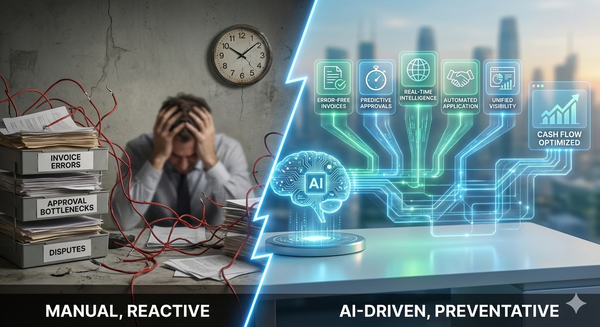
This is where AI-driven customer-to-cash platforms are creating step-change impact - not by pushing customers harder, but by removing friction internally.
Final Thought
If 5-7% of your cash is quietly trapped in customer-to-cash, that is not a collections problem.
It is not a customer problem.
It is a system design problem.
And unlike customer behavior, system design is entirely within your control.
The fastest way to improve cash flow in 2026 will not be stricter credit terms or more reminders. It will be eliminating the silent leakage that finance teams have learned to live with - but no longer need to.