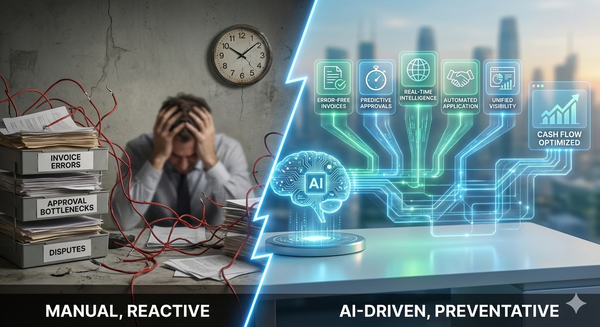
The Rise of the Receivable Engineer: How Customer-to-Cash Roles Are Being Rewritten in 2026
A new role emerges at the intersection of credit, collections, and payments

Over the past year, finance teams have invested heavily in automation. Invoicing is faster. Payments are more digital. Dashboards are more detailed.
And yet, one problem stubbornly remains.
Cash is still unpredictable.
Buyers pay late for different reasons. Risk shifts faster than credit limits. Cross-border payments introduce friction no single team fully owns. Disputes, FX volatility, and liquidity stress ripple through the system faster than humans can react.
By 2026, this tension forces a deeper change – not just in tools, but in roles.
The most important role in customer-to-cash is no longer collections, credit, or payments in isolation. A new role is emerging at the intersection of all three.
Welcome to the era of the Receivable Engineer.
Why Traditional AR Roles Are Breaking
Customer-to-cash was never designed for today's environment.
• Credit teams rely on point-in-time checks that age badly in volatile markets
• Collections teams react after invoices are already overdue
• Payment teams optimize rails, but often without real-time risk context
• Finance leaders measure DSO, but struggle to influence it proactively
Each function does its job – yet no one owns the system that turns revenue into cash.
As AI-driven buyers intelligence and cross-border payment orchestration mature, this fragmentation becomes the bottleneck. The challenge is no longer execution capacity. It is decision ownership.
Introducing the Receivable Engineer
A Receivable Engineer is not a traditional finance role with a new title. It is a fundamentally different mandate.
The Receivable Engineer designs, governs, and continuously tunes the systems that decide how cash flows.
Instead of asking:
"Why is this invoice overdue?"
They ask:
• "Why did the system allow this exposure?"
• "What signal did we miss?"
• "How should the workflow adapt next time?"
They don't chase outcomes. They engineer them.
What the Receivable Engineer Actually Does
In practice, the role sits across credit, collections, payments, and risk – translating policy into automated decisioning.
Typical responsibilities include:
• Designing dynamic credit exposure rules based on buyers intelligence, not static limits
• Defining when payments should route through cards, local rails, or alternative methods based on risk, cost, and urgency
• Setting escalation logic for late payments and disputes by buyer behavior, not invoice age alone
• Monitoring leading indicators such as dispute patterns, payment friction, FX stress, and liquidity signals
• Intervening manually only when the system flags true exceptions
By 2026, high-performing finance teams will spend less time reacting to problems – and more time improving the logic that prevents them.
From KPIs to Real-Time Decisioning
Traditional AR metrics are backward-looking.
DSO, aging buckets, and dispute rates describe what already happened. They rarely explain what to do next.
The Receivable Engineer shifts the focus from reporting to decisioning.
Instead of reviewing metrics weekly, they oversee systems that:
• Adjust follow-up cadence automatically when buyer risk changes
• Tighten or relax terms dynamically based on observed behavior
• Surface early warnings before cash is at risk, not after
Metrics still matter – but only as feedback loops to improve the system.
How This Role Reshapes the Finance Organization
The rise of the Receivable Engineer does not eliminate finance jobs. It changes where value is created.
• Fewer people are needed for repetitive follow-ups
• More emphasis is placed on exception handling and judgment
• Finance aligns more closely with sales and operations around shared risk signals
• Ownership of cash velocity becomes explicit, not distributed
This also improves governance. Automated decisioning, when designed correctly, is more auditable and consistent than manual overrides scattered across teams.
Skills That Matter in 2026
As this role emerges, the skill mix shifts.
More important:
• Systems thinking and process design
• Risk intuition combined with data literacy
• Ability to translate policy into automation
• Comfort working across finance, operations, and technology
Less important:
• Manual invoice chasing
• Spreadsheet-heavy reconciliations
• Enforcing static rules without context
The Receivable Engineer is not a data scientist – but they understand enough to ask the right questions and own the outcomes.
Why This Role Only Works with AI
The Receivable Engineer is a product of AI maturity.
• Buyers intelligence provides continuous risk signals
• Cross-border payment orchestration executes decisions in real time
• Automated monitoring closes the loop between behavior and action
Without AI, this role collapses back into manual effort. With AI, it becomes the control layer for customer-to-cash.
The 2026 Takeaway
In 2026, competitive advantage will not come from faster payment rails alone, nor from adding more finance headcount.
It will come from finance teams that can engineer cash outcomes at scale.
The real question for CFOs is no longer whether to automate receivables – but who in the organization owns the system that decides how cash flows.
That owner is the Receivable Engineer.
And for customer-to-cash, this role may define the next decade.