Top 5 Overseas Buyer Fraud Methods – And How AI Helps Prevent Them
Overseas buyer fraud exploits gaps between identity verification and operational decision-making. Here's how AI-driven buyer intelligence closes them.
Global trade has never been more accessible. Companies can reach new buyers across continents with unprecedented ease. But that same connectivity has created new opportunities for fraud.
Overseas buyer fraud is rising, particularly in cross-border B2B transactions where identity verification, payment visibility, and legal recourse are more complex.
For finance teams, the challenge is no longer just assessing creditworthiness. It is identifying whether the buyer is legitimate in the first place.
Traditional compliance checks like KYC and KYB provide a starting point. But modern fraud schemes move faster than static verification processes.
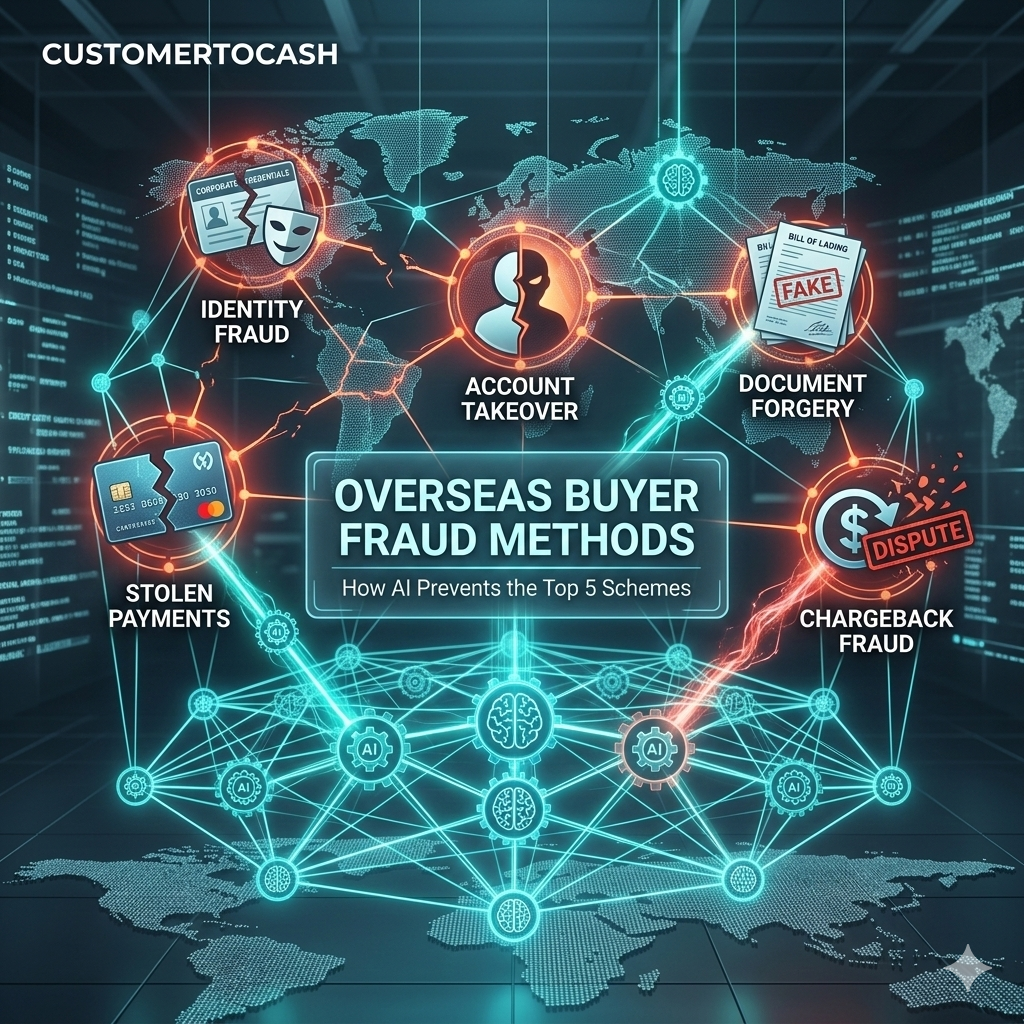
Here are the five most common overseas buyer fraud methods – and how AI-driven buyer intelligence helps detect and prevent them.
Overseas buyer fraud often passes traditional KYC checks because fraudsters impersonate legitimate companies. Behavioral intelligence is required to detect it.
Top Overseas Buyer Fraud Methods in Global Trade
The following five fraud methods represent the most common schemes targeting exporters and global sellers in B2B environments. Each exploits specific gaps in the customer-to-cash process.
According to the ICC (International Chamber of Commerce), trade fraud losses continue to rise as digital commerce expands cross-border reach without proportional improvements in fraud detection capabilities.
1. Business Identity Impersonation
One of the most common forms of overseas buyer fraud involves impersonating a legitimate company.
Fraudsters create convincing identities by:
• Registering similar company names
• Copying branding, websites, and email formats
• Using real company registration numbers
• Creating fake purchase orders and references
To the seller, the buyer appears legitimate. But the fraudster is exploiting the reputation of a real company.
How AI Prevents It
AI-based buyer intelligence analyzes multiple signals simultaneously:
• Domain registration history
• Email domain age and ownership
• Company registration inconsistencies
• Behavioral anomalies during onboarding
By cross-referencing identity signals globally, AI can detect impersonation patterns that manual checks often miss.
2. Shipping Diversion Fraud
In shipping diversion schemes, the buyer places a legitimate order but changes the delivery destination at the last moment.
This often occurs after goods are dispatched or during transit.
The fraudster may:
• Redirect shipments to alternative ports
• Use third-party logistics intermediaries
• Provide urgent delivery change instructions
Once the goods arrive at the diverted destination, recovery becomes extremely difficult.
How AI Prevents It
AI monitors transactional anomalies across the order-to-cash process.
Risk signals include:
• Sudden delivery address changes
• High-value first orders
• Geographic inconsistencies between buyer location and shipping address
AI flags suspicious changes before shipment approval, allowing finance and operations teams to pause fulfillment.
3. Payment Reversal and Chargeback Fraud
Some fraud schemes rely on manipulating payment systems.
Fraudsters may:
• Pay with reversible payment methods
• Initiate disputes after goods are delivered
• Claim unauthorized transactions
In cross-border environments, resolving these disputes can be extremely difficult. According to the FBI Internet Crime Complaint Center (IC3), international payment fraud is among the fastest-growing categories of reported cybercrime.
How AI Prevents It
AI-driven payment intelligence evaluates:
• Payment method risk levels
• Transaction patterns across buyers
• Country-specific fraud indicators
• Buyer payment history across networks
High-risk payment behaviors trigger additional verification or require secure payment methods.
4. Overpayment and Refund Fraud
Another tactic involves intentional overpayment.
The buyer sends a payment exceeding the invoice amount and requests a refund of the difference to a different account.
Shortly afterward, the original payment is reversed or identified as fraudulent.
This leaves the seller with both lost funds and unpaid goods.
How AI Prevents It
AI systems detect abnormal payment patterns, including:
• Overpayments relative to invoice value
• Refund requests to unrelated accounts
• Sudden payment behavior changes
Automated controls can block refund processing until transactions clear verification thresholds.
5. Credit Building Fraud
Some fraudsters operate patiently.
They begin with small, legitimate orders paid on time to establish trust. Over time, they request larger credit limits.
Once sufficient credit is granted, they place a large order and disappear without payment.
This scheme exploits traditional credit models that rely heavily on historical payment behavior.
How AI Prevents It
AI-powered buyer intelligence evaluates more than payment history.
It analyzes:
• Order velocity changes
• Exposure concentration risk
• Behavioral signals across similar fraud patterns
• External data on buyer activity and network risk
AI can identify when a buyer's growth pattern deviates from expected norms and flag potential credit building fraud early.
Why Overseas Fraud Is Harder to Detect
Cross-border trade introduces additional challenges:
• Limited visibility into foreign company records
• Jurisdictional differences in enforcement
• Language and regulatory barriers
• Fragmented identity data sources
Traditional fraud detection methods rely heavily on static documents and manual verification.
But modern fraud schemes are dynamic.
As Atradius notes, the complexity of cross-border credit risk is compounded by inconsistent data availability and the speed at which fraudulent actors adapt to verification processes.
How AI Helps Prevent Overseas Buyer Fraud
The most effective fraud prevention strategies now combine:
• Identity verification
• Behavioral analytics
• Payment intelligence
• Transaction monitoring
AI enables finance teams to analyze thousands of signals simultaneously across the customer-to-cash lifecycle.
Instead of detecting fraud after it occurs, companies can prevent it before goods ship or credit is extended.
This approach transforms fraud prevention from a reactive control into a predictive capability.
| Fraud Method | How AI Detects It |
|---|---|
| Identity impersonation | Cross-references domain, registration, and behavioral signals |
| Shipping diversion | Flags address changes and geographic inconsistencies |
| Payment reversal | Evaluates payment method risk and transaction patterns |
| Overpayment scams | Detects abnormal payment amounts and refund requests |
| Credit building fraud | Identifies order velocity anomalies and exposure concentration |
Final Thoughts
Overseas buyer fraud is not just a sales risk. It is a financial risk that directly impacts revenue, cash flow, and customer trust.
The five most common fraud methods – identity impersonation, shipping diversion, payment reversals, overpayment schemes, and credit building fraud – exploit gaps between identity verification and operational decision-making.
AI-driven buyer intelligence closes those gaps.
By embedding fraud detection directly into the customer-to-cash process, organizations can expand globally with greater confidence while protecting revenue and receivables.
In modern B2B commerce, fraud prevention is no longer just about verifying who the buyer is. It is about continuously understanding how they behave.
Is your current system equipped to detect overseas buyer fraud before credit is extended or goods are shipped? Evaluate whether your customer-to-cash process relies on static checks – or AI-driven credit risk intelligence. Explore the ROI Calculator to quantify the impact.