
The 90-Day Rule: How to Predict a Bad Payer Before They Cost You
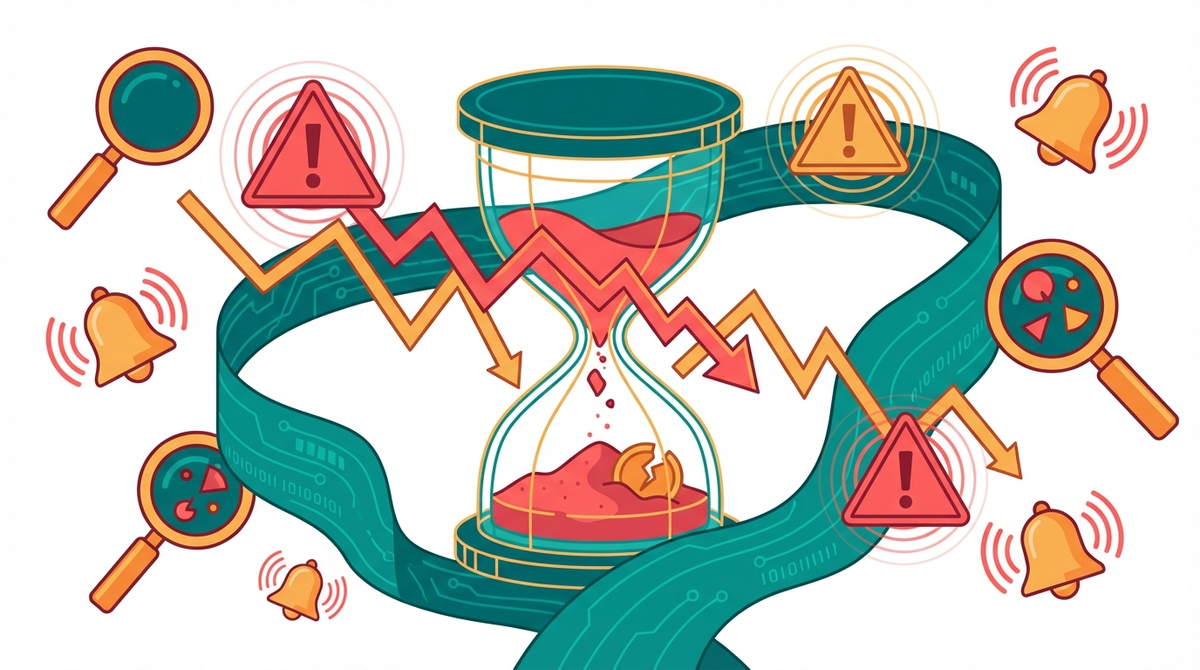
title: "The 90-Day Rule: How to Predict a Bad Payer Before They Cost You"
category: "Credit Risk Management"
author: "Dan Levin"
target_keywords: ["predict bad payer B2B", "payment risk early warning", "buyer payment behavior analysis", "B2B credit risk signals", "accounts receivable risk scoring"]
The 90-Day Rule: How to Predict a Bad Payer Before They Cost You
Here's something most AR teams learn the hard way: by the time a buyer defaults on a significant invoice, the warning signs were visible three months earlier.
Not always. Not in every case. But with enough consistency that I've come to think of it as the 90-day rule - the observation that buyer payment behavior deteriorates in a recognizable pattern roughly 90 days before a serious problem materializes.
The challenge isn't that the signals don't exist. It's that most companies aren't looking for them, or they're buried in data that nobody is analyzing until it's too late.
If you manage receivables - or if you're a CFO who'd rather not explain another bad debt write-off to the board - this framework will help you spot trouble before it costs you.
The 90-Day Deterioration Window
The 90-day pattern works like this: a buyer doesn't go from model customer to defaulter overnight. There's a deterioration curve, and it typically unfolds over a roughly 90-day window. Understanding this window gives you time to act.
Days 1-30: Subtle shifts. The earliest signals are easy to miss because they look like noise. A buyer who usually pays on day 28 starts paying on day 33. Not technically late - just slower. Or they pay the full amount on one invoice but short-pay another by a small amount. Or a dispute gets filed for the first time in a year. Any one of these events means nothing. In combination, they're the first tremor.
Days 30-60: Pattern emerges. The behavior changes become more consistent. Payment timing slows across multiple invoices, not just one. Disputes increase in frequency or complexity. Communication patterns shift - your AR contact at the buyer becomes harder to reach, or responses take longer. Partial payments appear where full payments were the norm. Order patterns may change too - either decreasing (they're pulling back) or increasing (they're stocking up before credit gets cut).
Days 60-90: Acceleration. The deterioration accelerates. Payments that were 5 days late become 15 days late. Disputes that were resolved in a week now drag for a month. The buyer starts making promises - "the check is in the mail" or "we'll pay everything next week" - without following through. If you're paying attention, the pattern is unmistakable by this point. If you're not paying attention, day 91 is when you discover a $300K receivable that's going to require litigation to collect - if you collect at all.
The 90-day window isn't magic. It reflects the typical timeline of a business under stress: leadership recognizes a cash flow problem, starts managing outflows (paying slower), tries to resolve the underlying issue, and either recovers or doesn't. Your invoices are one of many outflows being managed, and the payment behavior reflects the buyer's internal trajectory.
The Behavioral Signals That Matter
Not all payment behavior changes are equal. Here are the specific signals that are most predictive of serious payment problems, ranked roughly by how early they appear and how reliable they are.
Signal 1: Payment Timing Drift
This is the earliest and most reliable signal. Track not just whether a buyer pays late, but the trend in their payment timing.
A buyer who consistently pays on day 28 and starts paying on day 33, then 36, then 40 is showing timing drift. Each individual payment might still be within terms (if they're on Net 45), so your standard aging report won't flag it. But the trend is clear: their payment cycle is lengthening.
How to measure it: Calculate a rolling 90-day average of days-to-pay for each buyer. Compare it to their trailing 12-month average. If the 90-day average exceeds the 12-month average by more than 10-15%, that's a signal worth investigating.
Why it works: Buyers under cash pressure don't suddenly stop paying. They gradually stretch. The timing drift shows up before outright late payments because the buyer is still trying to maintain the relationship while managing their cash constraints.
Signal 2: Partial Payments
When a buyer starts paying less than the full invoice amount, pay attention. Partial payments take several forms:
- Short payments. Invoice is $50,000, payment comes in for $47,500. The buyer might claim a discount, a quality issue, or just send less without explanation.
- Cherry-picking invoices. The buyer has three open invoices and pays two, leaving the largest one unpaid. They're managing cash flow by controlling which obligations they fulfill.
- Round-number payments. Instead of paying the exact invoice amount, the buyer sends a round number - $100,000 against $127,432 in open invoices. This is often a sign they're paying based on available cash, not based on what's owed.
Why it works: Partial payments indicate the buyer has enough cash to pay something, but not everything. That's a fundamentally different situation than a buyer who's current on all obligations, and it almost always gets worse before it gets better.
Signal 3: Dispute Frequency and Character
Disputes are a normal part of B2B trade. Product quality issues, shipping discrepancies, pricing mismatches - these happen. What's abnormal is a change in dispute behavior.
Frequency increase. A buyer who filed one dispute in the past year suddenly files three in a month. The disputes themselves might be legitimate, but the pattern suggests the buyer is looking for reasons to delay payment.
Character change. Disputes shift from specific, resolvable issues ("this shipment was 50 units short") to vague, hard-to-resolve complaints ("the quality isn't meeting our expectations" or "we need to review the pricing structure"). Vague disputes are harder to resolve, which means the receivable stays in limbo longer - which is exactly the point if the buyer is managing cash flow.
Timing of disputes. A buyer who raises a dispute right before the payment due date - not when they received the goods - is likely using the dispute as a payment delay tactic. Legitimate quality issues get raised at receipt. Strategic disputes get raised at due date.
Signal 4: Communication Changes
This is qualitative, but experienced AR professionals know it's one of the most telling signals.
Decreased responsiveness. Your AR contact at the buyer goes from responding to emails within a day to taking a week. Phone calls go to voicemail. Meeting requests get postponed. People who are about to deliver bad news tend to avoid the conversation.
Contact rotation. You were dealing with the CFO or AP manager, and suddenly you're being redirected to a junior person who doesn't have authority to commit to payment dates. This is a distancing tactic - the decision-maker doesn't want to be in the conversation.
Overpromising. Paradoxically, a buyer who suddenly becomes very reassuring - "Don't worry, everything's fine, we'll pay everything next week" - may be more concerning than one who's simply slow to respond. Excessive reassurance without corresponding action is a classic pattern in deteriorating credit situations.
Proactive term renegotiation. A buyer who requests extended terms - "Can we move from Net 30 to Net 60?" - is telling you something about their cash position. This isn't inherently bad (it might be strategic), but if it coincides with other signals on this list, treat it as confirmation.
Signal 5: Order Pattern Changes
How a buyer orders can be as informative as how they pay.
Decreasing order frequency or size. If a buyer who ordered monthly starts ordering every other month, or their average order size drops by 30%, they may be pulling back because they can't afford current volumes. Or they may be diversifying to other suppliers - which means your leverage for collections decreases.
Increasing orders before slowing payments. This is the more dangerous pattern. A buyer places larger-than-normal orders while simultaneously slowing payments on existing invoices. They're effectively building inventory on your credit. If this behavior coincides with other deterioration signals, it's a red flag that should trigger immediate credit limit review.
Building a Scoring Model: From Signals to Action
Individual signals create awareness. A scoring model creates a system. Here's how to build one that's practical enough to implement without a data science team.
Step 1: Define your input signals. Start with the five categories above: payment timing drift, partial payments, dispute behavior, communication quality, and order pattern changes. These are your risk factors.
Step 2: Score each factor. Use a simple 0-3 scale for each:
- 0 = Normal behavior
- 1 = Minor deviation from baseline
- 2 = Significant change from historical pattern
- 3 = Severe deterioration
Step 3: Weight the factors. Not all signals are equal. Payment timing drift and partial payments are the strongest predictors. A simple weighting might be:
- Payment timing drift: 2x weight
- Partial payments: 2x weight
- Dispute behavior: 1.5x weight
- Communication changes: 1x weight
- Order pattern changes: 1x weight
Step 4: Set thresholds. With these weights, total scores range from 0 to 22.5. Based on typical distributions:
- 0-4: Green - normal behavior, continue monitoring
- 5-9: Yellow - increased monitoring, review credit limit
- 10-14: Orange - proactive outreach, consider tightening terms
- 15+: Red - immediate action required, escalate to management
Step 5: Automate what you can. Payment timing drift, partial payment patterns, and dispute frequency can all be calculated automatically from your AR data. Communication quality and order pattern changes might require manual input from your collectors or sales team. Even a partially automated model is vastly better than no model at all.
Step 6: Calibrate over time. Track your model's predictions against actual outcomes. Which buyers that scored Yellow actually became problems? Which Red-scored buyers recovered? Use this feedback to adjust weights and thresholds. A model that's been calibrated against 12 months of data will be significantly more accurate than the initial version.
When to Tighten Terms vs. When to Cut a Buyer Loose
Having a scoring model is valuable. Knowing what to do with the scores is critical. Here's a decision framework:
Tighten Terms When:
The buyer is strategically important and showing early-stage signals (Yellow zone). Don't cut a $1M annual account because their payment timing drifted by 5 days. Instead, reduce credit limits by 20-30%, shorten terms by 15 days, or require more frequent payments. Signal to the buyer that you're watching without torching the relationship.
The buyer communicates proactively. A buyer who calls you to say "we're having a tough quarter, can we work out a payment plan?" is showing good faith. Work with them. Restructure the receivable, get a written payment commitment with specific dates, and monitor compliance. Buyers who communicate are significantly less likely to default than buyers who go silent.
The deterioration is linked to a specific, temporary event. If you can identify why the buyer's payment behavior changed - a major customer loss, a natural disaster, a supply chain disruption - and the event is plausibly temporary, adjusting terms is reasonable. The key word is "temporary." If the underlying business model is broken, no amount of term adjustment will fix it.
You have security or recourse. If you hold personal guarantees, liens on assets, or trade credit insurance, you have more room to work with a struggling buyer because your downside is limited.
Cut a Buyer Loose When:
The buyer is in the Red zone and not communicating. Silence combined with severe deterioration across multiple signals is the worst combination. This is where most bad debt write-offs come from. Don't ship more product. Escalate collections. Engage legal counsel if the amount warrants it.
You see the stocking-up pattern. If a buyer is placing larger orders while paying slower - especially if they've recently requested extended terms - they may be building inventory ahead of an anticipated inability to pay. This is the B2B equivalent of maxing out a credit card before declaring bankruptcy. Stop extending credit immediately.
The buyer's industry is in structural decline. Sometimes the deterioration isn't about the individual buyer - it's about their market. If your buyer is in a sector facing permanent headwinds (not cyclical downturn - structural decline), the probability of recovery is low. Better to reduce exposure now than hope for a turnaround that isn't coming.
The math doesn't work. If a buyer represents $200K in annual revenue but requires $150K in constantly outstanding receivables, $20K in collections costs, and generates a dispute on every third invoice, the relationship isn't profitable even when they pay. Sometimes the right decision is to exit the relationship entirely and redeploy that credit capacity to better customers.
Making This Work in Practice
The 90-day rule isn't a crystal ball. It won't predict every default, and it will generate false positives. A buyer who triggers Yellow signals might simply be going through a reorganization that temporarily affects their payment process. That's fine - the system is designed to create awareness and prompt investigation, not to automatically terminate relationships.
What makes it work in practice:
Review the model weekly. Assign someone - a credit analyst, the AR manager, even the CFO for smaller companies - to review risk scores every week. Five minutes looking at a dashboard of buyer risk scores is worth more than hours of reactive collections work after a problem materializes.
Pair quantitative signals with qualitative intelligence. Your sales team talks to buyers regularly. Your collectors have a feel for who's struggling. Build a process for this qualitative input to reach the credit decision-makers. The best models combine data with human judgment.
Document your decisions. When you tighten terms or cut a buyer, write down why. When you decide not to act on a Yellow signal, write down why. This creates institutional memory and protects you in disputes. It also helps you calibrate the model by tracking decisions against outcomes.
Share the framework with sales. Your sales team will push back on tightened terms if they don't understand the reasoning. When they understand the 90-day rule and can see the data themselves, the conversation shifts from "finance is blocking my deal" to "we need to be smart about how we structure this account."
The Cost of Not Watching
I'll close with a number that usually gets attention: the average B2B bad debt costs 10-20 times the profit from the original sale to recover. A $100K write-off on a 10% net margin business means you need to sell an additional $1M just to break even.
That's the cost of not having an early warning system. Not the write-off itself - the revenue you need to generate to replace it.
The 90-day rule won't eliminate bad debt. No system will. But it gives you something invaluable: time. Time to tighten terms before exposure grows. Time to negotiate payment plans before the situation becomes adversarial. Time to shift credit capacity from deteriorating accounts to healthy ones.
In receivables management, time is literally money. Ninety days of warning is the difference between a managed outcome and a write-off.
What early warning signals have you found most reliable in predicting payment problems? Have you built scoring models for buyer risk, and how well are they working? I'd like to hear what the data is telling you in practice.