Stablecoins in B2B Trade: Hype vs. Reality for Receivables Teams
title: "Stablecoins in B2B Trade: Hype vs. Reality for Receivables Teams"
category: "Payments Innovation"
author: "Dan Levin"
target_keywords: ["stablecoins B2B payments", "USDC B2B trade", "stablecoins cross-border payments", "crypto B2B receivables", "stablecoin settlement B2B"]
Stablecoins in B2B Trade: Hype vs. Reality for Receivables Teams
Every few months, someone publishes an article declaring that stablecoins will revolutionize B2B payments. USDC will replace wire transfers. USDT will eliminate correspondent banking fees. Settlement in minutes, not days. The future is here.
Then you talk to an actual AR team processing cross-border receivables, and the response is usually something like: "That sounds nice. We still can't get our buyer in Turkey to pay the right amount on the right invoice."
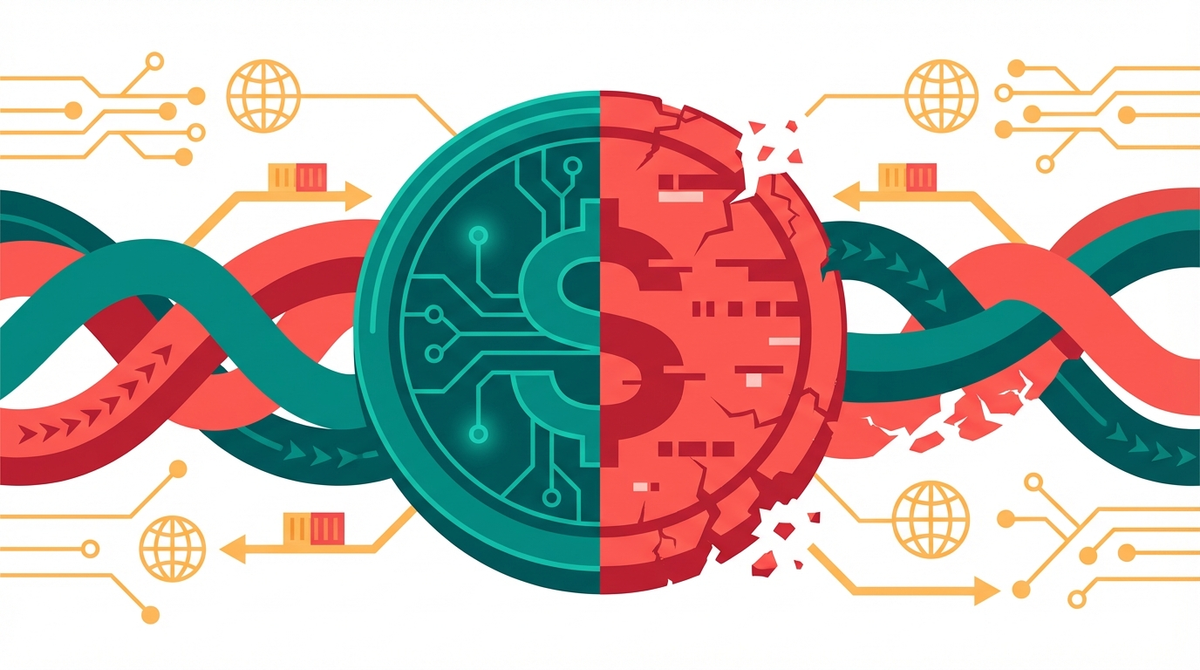
The truth about stablecoins in B2B trade sits somewhere between the hype and the dismissal. There are real use cases where stablecoins are genuinely solving problems today. There are also significant gaps where the technology - or more accurately, the surrounding infrastructure - isn't ready for enterprise adoption.
If you manage receivables for a company that sells internationally, here's an honest assessment of where things actually stand.
Where Stablecoins Are Actually Being Used in B2B Today
Let's start with what's real. Stablecoins have found genuine traction in specific B2B trade corridors, and understanding where and why is more useful than broad generalizations.
Emerging market to USD settlements. This is the biggest real use case. If you're a supplier in the US or Europe and your buyer is in Nigeria, Kenya, Argentina, or Turkey, getting paid through traditional banking rails can be painful. Correspondent banking chains in these corridors are slow (3-7 business days), expensive (fees can eat 3-5% of the transaction), and unreliable (payments get held, compliance checks add delays, and intermediary banks take opaque fees).
Stablecoins - primarily USDC and USDT - offer an alternative. The buyer converts local currency to USDC through a local exchange or OTC desk, sends it to the supplier's wallet, and the supplier converts to fiat in their home market. Total time: hours, not days. Total cost: typically under 1%, sometimes significantly less.
This isn't theoretical. Companies running trade finance operations across Africa, Latin America, and parts of Southeast Asia are processing meaningful volume through stablecoin rails today. Not as an experiment - as a primary payment channel for specific corridors.
Dollar-denominated payments from countries with capital controls. In markets where accessing USD through the banking system is restricted or requires bureaucratic approval, stablecoins provide an alternative channel. A buyer in Argentina who would need weeks to get central bank approval for a USD wire transfer can purchase USDC on a local exchange and settle in hours.
This is a pragmatic solution to a real problem - but it comes with significant regulatory and compliance considerations that I'll address below.
Intra-company transfers and treasury operations. Some multinational companies are using stablecoins for internal transfers between subsidiaries - moving liquidity from one market to another without the fees and delays of international wire transfers. This is less about paying receivables and more about treasury optimization, but it touches the same infrastructure.
Small and mid-market cross-border transactions. For payments in the $10K-$500K range, the economics of stablecoins can be significantly better than wire transfers. At this transaction size, a $40-50 wire fee plus intermediary bank charges plus FX spread can add up to a material percentage of the payment. Stablecoin settlement costs are largely fixed regardless of transaction size.
The Settlement Speed Advantage - And Its Limits
The most cited benefit of stablecoins is settlement speed. A USDC transfer on Ethereum settles in about 15 minutes. On Solana or other faster chains, it's seconds. Compare that to the 2-5 business day timeline for international wire transfers, and the appeal is obvious.
But speed of blockchain settlement and speed of actual cash-in-hand are not the same thing.
On-ramp and off-ramp friction. The stablecoin itself moves fast. But converting fiat to stablecoin (on-ramp) and stablecoin back to fiat (off-ramp) still involves traditional banking infrastructure. Your buyer needs to purchase USDC - that requires a bank transfer to an exchange, which can take 1-2 business days. On the receiving end, you need to convert USDC to fiat and deposit into your bank account - another 1-2 business days.
So while the middle leg of the journey takes minutes, the end-to-end timeline might be 2-3 days. Still faster than a traditional wire through multiple correspondent banks, but not the "instant settlement" that the marketing materials promise.
Liquidity matters. In major currency pairs - USD, EUR - the on-ramp and off-ramp markets are liquid and efficient. In emerging markets, liquidity can be thinner. Converting $1M of Nigerian naira to USDC without significant market impact requires working with OTC desks, and the spread you pay effectively becomes a transaction fee. For smaller amounts, exchange order books may be sufficient. For larger B2B transactions, you need to plan the conversion carefully.
Settlement finality. One genuine advantage of blockchain-based settlement is finality. Once a USDC transaction confirms on-chain, it's done. There's no recall, no chargeback, no "sorry, the intermediary bank returned the payment." For receivables teams that have dealt with payment reversals and returned wires, this is a meaningful benefit.
The Regulatory Landscape: Clearer Than You Think (In Some Places)
Regulation is usually cited as the biggest obstacle to stablecoin adoption in B2B. And two years ago, that was largely true. The landscape has evolved significantly since then.
The US. The regulatory picture in the US has clarified considerably through 2025. The SEC and CFTC have provided frameworks distinguishing payment stablecoins from securities. Major issuers like Circle (USDC) operate under state money transmitter licenses and publish regular attestations of reserves. Banks are increasingly comfortable with stablecoin on-ramps and off-ramps. It's not the Wild West anymore - it's regulated financial infrastructure with clear compliance obligations.
The EU. MiCA (Markets in Crypto-Assets Regulation) came into full effect and provides a comprehensive framework for stablecoin issuance and usage. Licensed stablecoin issuers can operate across the EU with a single authorization. For B2B use, this has removed much of the regulatory uncertainty that previously made European companies hesitant.
Asia. Singapore, Hong Kong, and Japan have clear stablecoin frameworks. Other markets are moving at different speeds. India remains restrictive. China has its own digital currency approach that doesn't include Western stablecoins.
The challenge markets. In some of the corridors where stablecoins are most useful - Nigeria, Argentina, Turkey - the regulatory environment is complex or openly hostile. Using stablecoins to circumvent capital controls may solve a payment problem but create a compliance problem. This is an area where legal counsel isn't optional.
For the AR team: The practical question isn't "are stablecoins legal?" (in most developed markets, yes) but "can we accept stablecoin payments and remain compliant with our KYC/AML obligations?" The answer depends on your jurisdiction, your compliance framework, and the specific corridors you're operating in. For US and EU companies accepting payments from buyers in well-regulated markets, the path is increasingly clear. For more complex corridors, you need specialized guidance.
Integration Challenges: The Unsexy Part
Here's where the conversation usually gets less exciting. Even if the economics and speed make sense, integrating stablecoin payments into your existing customer-to-cash infrastructure is non-trivial.
ERP integration. Your ERP needs to record stablecoin payments. What currency code do you use? How do you handle the FX conversion - at what rate and what timestamp? Where do you record the blockchain transaction reference? Most ERPs don't have native stablecoin support, so you're looking at custom fields, workaround journal entries, or middleware. It works, but it's not elegant.
Cash application. Matching an on-chain payment to an open invoice requires mapping blockchain wallet addresses to customer accounts and reconciling transaction amounts (which may differ from invoice amounts due to gas fees or conversion spreads). Traditional remittance advice doesn't exist in the blockchain world unless you build it into your process.
Treasury management. If you're holding stablecoins - even briefly - they need to be accounted for in your treasury position. What's your policy on stablecoin balance limits? How quickly do you convert to fiat? Who has custody of the private keys? These are operational questions that traditional payment methods don't raise.
Audit trail. Your auditors need to trace every payment from buyer to your bank account. With traditional payments, the bank statement is the evidence. With stablecoins, the audit trail spans a blockchain explorer, potentially an exchange or OTC desk, and then a bank deposit. It's all traceable - blockchain is inherently transparent - but your audit team needs to be comfortable with the process.
Tax treatment. In some jurisdictions, receiving payment in stablecoins may trigger different tax treatment than receiving fiat currency. Consult your tax advisor, because this varies significantly by country.
Which Trade Corridors Benefit Most
Based on what's actually happening in the market, here's where stablecoins provide the most value for B2B receivables teams:
High value, clear winner: US/EU supplier selling to buyers in Sub-Saharan Africa. Traditional banking rails are slow, expensive, and unreliable. Stablecoin settlement is often the best available option for speed and cost. If you regularly collect from Nigeria, Kenya, Ghana, or South Africa, stablecoins deserve serious consideration.
Strong use case: US/EU supplier selling to Latin American buyers, particularly in Argentina, Colombia, and Brazil. Dollar access is valuable to buyers in these markets, and the banking infrastructure - while functional - is expensive for cross-border payments.
Emerging use case: Intra-Asian trade, particularly involving smaller Southeast Asian markets. The traditional correspondent banking network in ASEAN is fragmented, and stablecoins are starting to fill gaps for mid-market transactions.
Limited advantage: US-to-EU, US-to-UK, or intra-EU payments. The traditional payment rails in these corridors (SWIFT gpi, SEPA, Faster Payments) are already fast, cheap, and reliable. Stablecoins don't offer enough improvement to justify the integration effort and operational complexity.
Limited advantage: Very large transactions ($10M+). At this scale, the banking system works reasonably well, and the liquidity requirements for stablecoin conversion become significant. Traditional wire transfers with negotiated FX rates are often more economical.
What Still Doesn't Work
Being honest about the limitations is important, because overselling the technology hurts adoption when reality doesn't match expectations.
No standard invoicing integration. There's no widely adopted standard for including stablecoin payment instructions on a B2B invoice. Wallet addresses, network selection, and payment references are handled ad hoc. This creates friction and increases the risk of payment errors.
Buyer education and comfort. Many B2B buyers - especially larger corporations - are not equipped to send stablecoin payments. Their treasury teams may not have crypto exchange accounts, wallet infrastructure, or internal approval to transact in digital assets. You can't unilaterally decide to accept stablecoins; your buyer needs to be able to send them.
Volatility risk during conversion. While stablecoins themselves maintain their peg (USDC has been remarkably stable), the conversion from buyer's local currency to stablecoin introduces FX risk. If a Nigerian buyer converts naira to USDC, the naira/USD rate at conversion may differ from the rate assumed when the invoice was issued. This is the same FX risk that exists with traditional payments, but the informal nature of some conversion markets can make the spread wider.
Counterparty risk on exchanges. If your buyer purchases USDC on a local exchange and that exchange fails or freezes funds, the payment doesn't arrive. The collapse of FTX in 2022 is a distant memory, but it illustrated that exchange counterparty risk is real. Stick with regulated, well-capitalized exchanges and OTC desks.
Smart contract risk. USDC and USDT are smart contracts on various blockchains. While these specific contracts have been extensively audited and have years of production history, the theoretical risk of a smart contract vulnerability exists. For the major stablecoins, this risk is extremely low - but it's not zero.
Scalability of off-ramps. In some markets, converting large volumes of stablecoins to fiat currency at competitive rates remains challenging. The off-ramp infrastructure is improving but hasn't reached the reliability and depth of traditional banking in all corridors.
A Practical Approach for Receivables Teams
If you're considering stablecoins for your B2B collections, here's a pragmatic path:
Step 1: Identify the corridors. Look at your AR by geography. Where are payments slowest, most expensive, or most unreliable? Those are your candidate corridors.
Step 2: Talk to your buyers. Before building infrastructure, ask your top buyers in those corridors if they'd be willing and able to pay via stablecoin. You might be surprised - some may already be using stablecoins for other supplier payments.
Step 3: Start with a pilot. Pick 5-10 transactions with willing buyers in a single corridor. Use a regulated exchange or payment provider that handles the conversion on both ends. Don't build custom infrastructure for a pilot.
Step 4: Solve the accounting. Work with your controller and auditors to establish the recording and reporting process before you scale. Getting this right at small volume is much easier than retrofitting at scale.
Step 5: Evaluate and expand. After 90 days, compare the stablecoin transactions to traditional payments on speed, cost, and operational effort. If the economics work, expand to more buyers and more corridors.
The Honest Forecast
Stablecoins are not going to replace SWIFT for most B2B payments anytime soon. They don't need to in order to be valuable.
Where they add real value - specific trade corridors where traditional banking is slow, expensive, or unreliable - they're already being used by pragmatic finance teams who care about results more than ideology.
The infrastructure is maturing. The regulation is clarifying. The integration tools are improving. In 2-3 years, accepting stablecoin payments will be as unremarkable as accepting wire transfers from different countries - just another payment method in the AR team's toolkit.
For now, the right approach is neither hype nor dismissal. It's targeted experimentation in the corridors where the benefit is clearest, with rigorous attention to compliance and accounting.
The receivables teams that figure this out early will have a genuine speed and cost advantage in the trade corridors that matter most.
Is your company accepting - or considering - stablecoin payments for B2B transactions? Which corridors are you finding most promising, and what obstacles have you run into? I'd like to hear from teams that are actually doing this, not just thinking about it.